 Investors


Arica, Chile – September 24, 2026
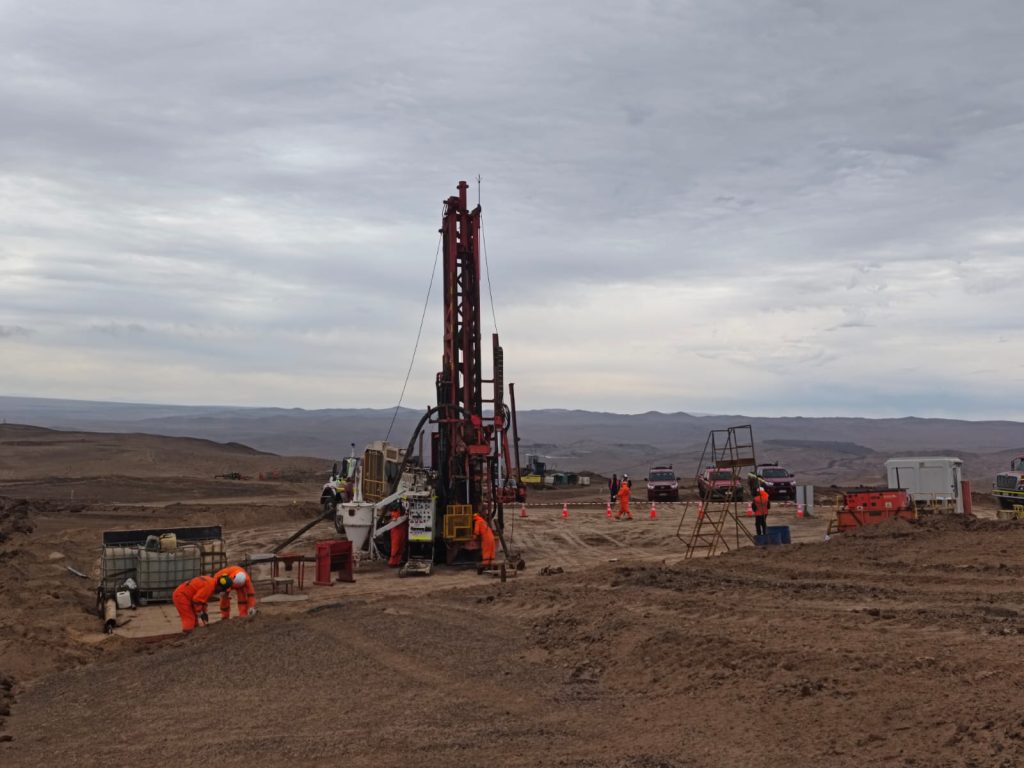
Pampa Camarones SpA (BCS:CAMARONEX) (“Pampa Camarones” or the “Company”) is pleased to announce the first assay results from its 2026 scouting drilling campaign, corresponding to the Golondrina target, the first of six priority targets in the program.
Results from the first five RC drill holes (921 metres) confirm positive pXRF results in the area west of the Golondrina Cu-(Ag) vein system, currently under development. These results are beginning to define a new high-grade copper mineralized domain, with potential for near-term, low-capital resource growth. This is a fully blind zone with no prior drilling, similar to the area south of the mine, where attractive widths and grades have been found.
Highlights:
Three “step-out” holes drilled west of the Golondrina mine (RC_26-GL003: 250 m; RC_26-GL004: 200 m; and RC_26-GL005: 160 m) intersected a new vein system in a blind zone with no prior drilling, which also extends the recognized mineralization below the mine’s current deepest level.
The longest intercept was 25.0 metres at 2.98% CuT (pXRF, laboratory results pending) in hole RC_26-GL004, between 156.0 and 181.0 metres (see Table 1). It should be noted that this intercept width is likely influenced by the drilling angle relative to the vein.
Two holes drilled on the mine’s northeast projection (RC_26-GL001: 110 m; RC_26-GL002: 201 m) confirmed continuity of high-grade mineralization in true widths of approximately 1 metre, including 2.0 metres at 1.76% CuT (laboratory) in RC_26-GL002 (see Table 1). This information is key to continuing mine advances, following a low-grade zone encountered in the drift heading toward this area.
Laboratory results from the first three holes validate the accuracy of the pXRF sampling used as a preliminary field control tool (see Figure 2).
These results indicate the Golondrina system —currently under development— could add at least three new veins to the mine plan.
The program has advanced to its next targets, Aida, with four holes (975 m), and Gattavara, with four holes (1,240 m), currently underway.
Rodrigo Ramírez, Chief Executive Officer of Pampa Camarones, commented: “These first Golondrina results are highly encouraging. We are recognizing a fully blind, high-grade mineralized domain immediately west of a mine under development, which represents a low-capital, near-term growth opportunity. This is complemented by the westward continuity of the main vein, an area with a strong historical track record of good widths and grades. The program is advancing as planned, and we expect new results over the coming weeks.”
Golondrina Vein System — Geology and Context of Results
Phase 1 drilling in the Golondrina Cu-(Ag) vein system has identified three veins with potential to be added to the mine plan, all of them blind with no surface expression, in addition to westward continuity of one of the mine’s historically best-grading veins.
One of the three veins had previously been interpreted based on historical drilling west of the mine; it was intersected by surface trenching, confirming its strike, and has recently begun to be recognized in mine workings in that same sector.
The other two veins are completely blind and located west of the mine: one was intersected by two drill holes over a 120-metre strike length, and the other by a single hole.
In addition, possible westward continuity was identified for the vein currently under development, which has delivered good results along drifts on five mine levels (N940, N920, N900, N880 and N860).
Drilling Program Overview
In August 2026, the Company announced the start of a 10,000-metre (40-hole) scouting drilling program, with two main objectives: (i) extending the oxide resources that can be readily incorporated into the mine plan, and (ii) delineating new deposits with the potential to significantly increase the Company’s resource base. This is part of Pampa Camarones’ long-term strategy of increasing production beyond what is currently contemplated.
The program is structured in two phases: the first, comprising 5,900 metres, is designed to explore six priority targets in the Company’s pipeline; and a second phase of 4,100 metres will follow up on the best results from the first. Drill holes average between 150 and 500 metres in depth, and the exploration targets include both copper-oxide vein systems and stratabound bodies associated with potential hydrothermal breccias.
The targets and their drilling sequence are: Golondrina (vein system and underground mine under development), Aida (vein system), Gattavara (possible vein system on the southern projection of the producing underground Salamanqueja mine), Lorenzo (vein system), Dorothy (stratabound) and Ana Gloria (stratabound).
Total exploration target potential is estimated at 12 to 19 million tonnes grading greater than 1.2% Cu(3).
3. The size and grade of the exploration targets are conceptual in nature; there has been insufficient exploration to date to define a mineral resource, and it is uncertain if further exploration will result in the targets being delineated as a mineral resource.
The program is advancing as planned: the first target, Golondrina, was completed with 921 metres drilled, and the campaign is now continuing at the Aida target —a copper-oxide vein system analogous to the Golondrina and Salamanqueja systems— with results expected in the coming weeks.
Next Steps
Drilling will next move to the southern end of the Salamanqueja mine, known as Gattavara, while a new drilling phase is prepared at Golondrina. This new phase will include confirmation and infill drilling on the three identified veins, along the western extension of the east-west producing structure, and toward the mine’s southern sector, which remains undrilled and fully concealed.
Sampling and QA/QC Procedure
Preliminary field pXRF sampling is performed using an Olympus DPO-6000-C instrument, taking five readings per sample; the reported result corresponds to the average of these five readings. Laboratory results from the first three holes confirm a strong correlation for this methodology in the preliminary estimation of copper grades (R² = 0.9893), and pXRF values are therefore used as a field reference while definitive laboratory assay results are pending.
About Pampa Camarones
Pampa Camarones is a Chilean company dedicated to the mining and development of copper projects, controlled by investment funds of Minería Activa. The company operates the Pampa Camarones mining district, located in northern Chile.
Loading Viewer...